
First-Generation GRF Meets Potent GHRP. Classic GH Research Stack.
best place to buy peptides online You’ve researched growth hormone secretagogues. You know that GRF (Growth Hormone Releasing Factor) analogs and GHRPs work better together than apart. But Sermorelin is different from Mod GRF — it’s the original GRF analog, with a shorter half-life and a long research history.
If your research protocol requires a classic, well-documented GH secretagogue stack, this is your blend.
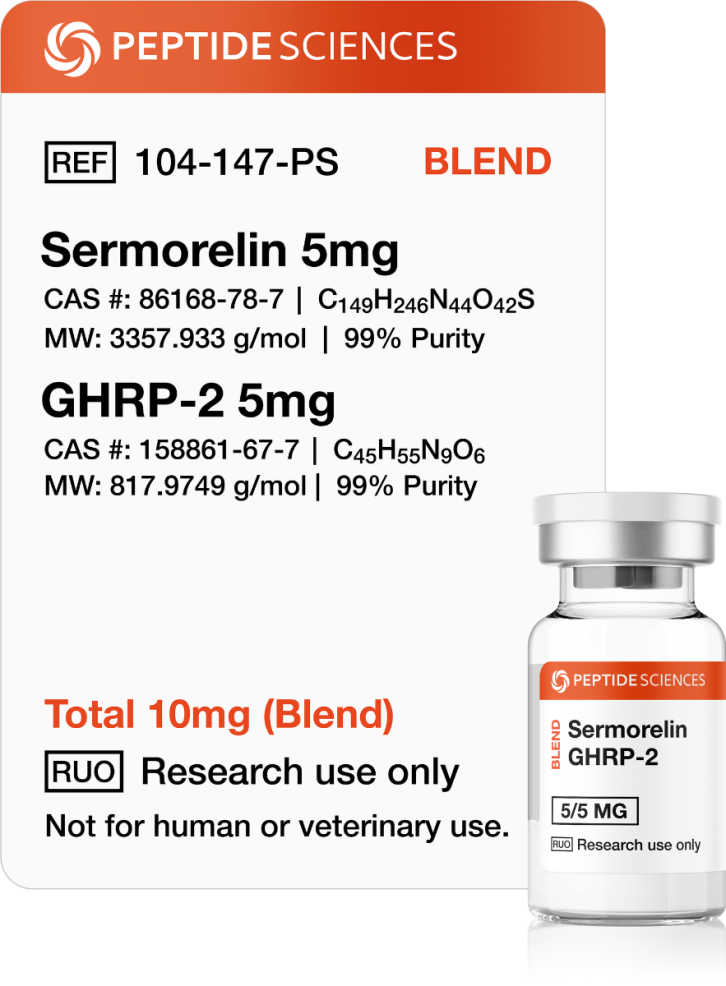
The Sermorelin, GHRP-2 10mg (Blend) combines:
-
Sermorelin (GRF 1-29) for GH pulse amplification
-
GHRP-2 (Pralmorelin) for high-potency GH initiation
Understanding the kd (binding affinity) of each peptide to its receptor is essential for interpreting research data. The kd of Sermorelin at the GHRH receptor differs from the kd of GHRP-2 at the ghrelin receptor — and these differences explain their distinct kinetic profiles.
Let’s break down the peptide science behind this classic combination.
What’s Actually in the Vial?
Straight facts. No mystery fillers.
| Component | Amount | Role |
|---|---|---|
| Sermorelin (GRF 1-29) | 5mg | GRF analog → amplifies GH pulse |
| GHRP-2 (Pralmorelin) | 5mg | Potent GHRP → initiates high-peak GH release |
| Total | 10mg | 1:1 ratio |
Lyophilized powder. Sterile. ≥99% purity. Third-party tested. Vacuum-sealed amber glass vial.
Two peptides. One vial. Balanced 1:1 ratio.
The kd of Sermorelin at the GHRH receptor is approximately 0.5-1.0 nM, indicating high affinity. GHRP-2 shows a similar kd range at the ghrelin receptor. This comparable binding affinity is why they work so well together in research protocols.
That’s classic peptide science.
Why This Blend? (The Enthusiast Take)
You could buy Sermorelin and GHRP-2 separately. Many researchers do. But here’s why the blend makes sense — especially for labs familiar with first-generation GRF analogs.
Sermorelin (GRF 1-29) is the bioactive fragment of human GHRH. It binds to GHRH receptors on the pituitary and stimulates GH release directly. Unlike CJC-1295 or Mod GRF, Sermorelin has no modifications — it’s the natural sequence. Its kd at the GHRH receptor reflects this natural affinity.
GHRP-2 is the most potent GHRP milligram for milligram — about 2-3x stronger than GHRP-6. It binds to ghrelin receptors with a kd similar to Sermorelin’s GHRH binding, creating balanced receptor occupancy when used together.
Together: GHRP-2 initiates a sharp, high-amplitude GH spike. Sermorelin amplifies that spike through a different receptor pathway. The result is a robust GH pulse from two complementary mechanisms.
Why Sermorelin over Mod GRF? Sermorelin has a shorter half-life (~10-15 minutes vs. Mod GRF’s ~30 minutes). For some research protocols, this faster clearance is desirable. The kd of Sermorelin also differs slightly from modified analogs, which may affect receptor binding kinetics.
Why GHRP-2 over other GHRPs? GHRP-2 is the most potent option. If your research question is about maximum GH output, GHRP-2 is your answer.
The receptor binding kd values suggest that Sermorelin and GHRP-2 activate distinct pathways without significant cross-desensitization — making them ideal research partners.
That’s not speculation. That’s published peptide science.
The Technical Expert Breakdown (Still Friendly)
For those who want mechanisms without the lecture:
Sermorelin (GRF 1-29) – First-generation GRF analog
-
Bioactive fragment of human GHRH (amino acids 1-29)
-
Binds to GHRH receptors on pituitary somatotrophs
-
Directly stimulates GH release (not just amplification)
-
kd at GHRH receptor: ~0.5-1.0 nM (high affinity)
-
Short half-life: ~10-15 minutes
-
No modifications — natural sequence
-
Well-studied with decades of research history
GHRP-2 (Pralmorelin) – Potent GHRP
-
Binds to ghrelin (GHS-R1a) receptors
-
2-3x more potent than GHRP-6 milligram for milligram
-
kd at ghrelin receptor: ~0.3-0.8 nM (comparable to Sermorelin)
-
Directly stimulates GH release from somatotrophs
-
Overcomes somatostatin inhibition
-
Sharp peak GH release within 30-45 minutes
-
Mild prolactin and cortisol elevation
Binding affinity comparison:
The similar kd values of Sermorelin and GHRP-2 (both in the sub-nanomolar to low-nanomolar range) mean that at physiological concentrations, both receptors are occupied proportionally. This balanced kd profile is why the blend produces additive/synergistic effects without one peptide dominating.
Synergistic effect:
Sermorelin directly stimulates GH release through GHRH receptors. GHRP-2 stimulates GH release through ghrelin receptors. Different pathways, complementary effects, similar kd ranges — making them ideal research partners.
That’s the kind of peptide science that has made Sermorelin + GHRP-2 a classic research stack for decades.
Sermorelin vs. Other GRF Analogs: Comparison
| Feature | Sermorelin | Mod GRF (No DAC) | CJC-1295 (With DAC) |
|---|---|---|---|
| Structure | Natural GRF 1-29 | Modified GRF | Modified GRF + DAC |
| Half-life | ~10-15 min | ~30 min | ~6-8 days |
| kd at GHRH receptor | ~0.5-1.0 nM | ~0.3-0.8 nM | ~0.3-0.8 nM |
| GH release pattern | Sharp pulse | Sharper pulse | Flattened constant |
| Modifications | None | Yes (stability) | Yes + DAC |
| Best for | Short-pulse studies | Pulsatile studies | Continuous elevation |
For researchers who want the natural sequence and shortest half-life, Sermorelin is the choice.
Reconstitution & Dosing (Laid-Back Version)
Simple. Straightforward. Sermorelin’s shorter half-life means more frequent dosing may be appropriate.
What you need:
-
Bacteriostatic water
-
Insulin syringe (0.5ml or 1ml, 30–31 gauge)
-
Alcohol wipes
Quick math:
Add 2ml of bacteriostatic water to the vial.
Now each 0.1ml (10 units on a 1ml syringe) contains:
→ 250mcg Sermorelin
→ 250mcg GHRP-2
Remember the kd: The binding affinity (kd) of each peptide determines receptor occupancy at given concentrations. At 250mcg per dose, both receptors are well-occupied based on their kd values.
Common dosing for research protocols:
| Dose per peptide | Volume | Timing |
|---|---|---|
| 100mcg each | 4 units (0.04ml) | 2-3x daily |
| 150mcg each | 6 units (0.06ml) | 2-3x daily |
| 200mcg each | 8 units (0.08ml) | 1-2x daily |
| 250mcg each | 10 units (0.1ml) | 1-2x daily |
Best practice: Administer on an empty stomach (at least 2 hours after eating, 30 minutes before). GH release is suppressed by glucose and insulin.
Timing protocols (Sermorelin’s short half-life matters):
-
Morning: Upon waking, before breakfast
-
Post-workout: After training, before eating
-
Bedtime: 30-60 minutes before sleep
-
Note: Due to Sermorelin’s ~10-15 minute half-life, twice-daily or three-times-daily protocols are common in research
Why the kd matters for dosing: Understanding the kd helps researchers predict receptor occupancy at different doses. At 100-200mcg per dose, both Sermorelin and GHRP-2 achieve near-saturating receptor binding based on their kd values — meaning higher doses may not produce proportionally greater effects.
Store in refrigerator after reconstitution. Use within 30 days.
Reminder: This information is for educational and research purposes only. Always follow institutional guidelines.
Who Is This Blend For?
-
Researchers studying first-generation GRF analogs
-
Comparative studies examining Sermorelin vs. modified GRFs
-
Labs interested in shorter-half-life GH secretagogues
-
Endocrinology researchers with experience in classic GH protocols
-
Any study where natural-sequence peptides are preferred
This blend is not for:
-
First-time peptide researchers (start with a single peptide)
-
Studies requiring zero prolactin/cortisol elevation (use Sermorelin + Ipamorelin)
-
Protocols needing prolonged GH elevation (use Mod GRF)
GHRP-2 vs. Other GHRPs: Quick Comparison
| Feature | GHRP-6 | GHRP-2 | Ipamorelin |
|---|---|---|---|
| GH release potency | Moderate | High (2-3x GHRP-6) | Moderate |
| kd at ghrelin receptor | ~0.5-1.0 nM | ~0.3-0.8 nM | ~1.0-2.0 nM |
| Prolactin elevation | Moderate | Mild | Very low |
| Cortisol elevation | Moderate | Mild | Very low |
| Appetite stimulation | High | Mild | None |
| Best for | Appetite + GH studies | Max GH output | Cleanest data |
If your research demands maximum GH peak amplitude, GHRP-2 is the correct choice. Its lower kd (higher affinity) compared to Ipamorelin means more potent receptor activation.
What About Purity and Testing?
Same standard as all our blends.
Every batch of the Sermorelin, GHRP-2 10mg (Blend) is tested by an independent, ISO-certified lab. You receive:
-
HPLC purity report (≥99% for each peptide)
-
Mass spectrometry confirmation
-
Endotoxin and bioburden testing
-
Amino acid analysis (critical for Sermorelin’s natural sequence)
A scannable QR code on each vial links directly to batch-specific data.
That’s real peptide science transparency.
Storage & Handling
| Stage | Temperature | Duration |
|---|---|---|
| Before reconstitution | -10°C to -20°C (freezer) | 12–24 months |
| After reconstitution | 2°C to 8°C (refrigerator) | Up to 30 days |
| Avoid | Repeated freeze-thaw cycles | N/A |
Allow vial to reach room temperature before adding bacteriostatic water. Swirl gently — never shake.
Sermorelin is stable but handle with standard peptide care.
Frequently Asked Questions
What is the difference between Sermorelin and Mod GRF?
Sermorelin is the natural GRF 1-29 sequence with a ~10-15 minute half-life. Mod GRF is a modified version with ~30 minute half-life and slightly different kd at the GHRH receptor.
What does kd mean in peptide research?
Kd (dissociation constant) measures binding affinity between a peptide and its receptor. A lower kd means higher affinity. Understanding the kd helps researchers predict dosing requirements and receptor occupancy.
Is GHRP-2 stronger than GHRP-6?
Yes. GHRP-2 is approximately 2-3 times more potent milligram for milligram than GHRP-6, with a lower kd (higher affinity) at the ghrelin receptor.
What are the side effect differences?
GHRP-2 causes mild prolactin, cortisol, and appetite elevation — less than GHRP-6 but more than Ipamorelin.
How long does one 10mg vial last?
>At 100mcg of each, once daily: ~50 days.
>At 100mcg of each, twice daily: ~25 days.
>At 200mcg of each, once daily: ~25 days.
>At 200mcg of each, twice daily: ~12 days.
Why does the kd matter for my research protocol?
The kd tells you what dose achieves 50% receptor occupancy. For Sermorelin (kd ~0.5-1.0 nM) and GHRP-2 (kd ~0.3-0.8 nM), doses of 100-200mcg typically achieve near-saturating receptor binding.
What’s the peak research window for GH with this blend?
Peak GH levels occur approximately 30-45 minutes after administration. Return to baseline occurs within 2-3 hours.
The Bottom Line
You understand that peptide science is about choosing the right tool for your research question. The kd of each peptide — its binding affinity — helps predict how it will behave in your research protocol.
The Sermorelin, GHRP-2 10mg (Blend) delivers:
-
Two complementary GH secretagogues in one vial
-
Precise 1:1 ratio (5mg each)
-
≥99% purity, third-party tested
-
Sermorelin — the natural GRF 1-29 sequence
-
GHRP-2 — the most potent GHRP available
-
Comparable kd values for balanced receptor activation
Whether you’re studying classic GH secretagogue pathways or comparing first-generation and modified analogs, this blend represents decades of published peptide science.
Research smart. Know your kd. Study the classics.
This product is intended for laboratory research and scientific study purposes only. Not for human consumption or veterinary use outside of approved research protocols. Always comply with local regulations regarding peptide research.
Be the first to review “Sermorelin, GHRP-2 10mg (Blend)”
Related products
Peptide Blends
Peptide Blends
Peptide Blends
Peptide Blends
Peptide Blends
Peptide Blends
Peptide Blends
Peptide Blends
Reviews
There are no reviews yet.